An undersized conveying plant becomes the bottleneck at harvest: the trailer waits, intake backs up, the dryer runs empty. An oversized plant, on the other hand, costs unnecessary money to buy and energy to run. Anyone planning anew or expanding should therefore pin down three figures before deciding on a system: the required throughput in tonnes per hour, the conveying route with its length and height, and the question of whether the equipment is to be permanently installed or used mobile.
This guide brings the documented performance data of the Kongskilde conveying systems together in one comparison table and shows step by step how to get from your requirement to the right system choice.
The three planning figures: volume, route and incline
The throughput is governed by peak demand, not by the average. What usually matters is grain intake during harvest: how many tonnes per hour must move away from the trailer so that the haulage chain does not stall? For simple transfers outside the season, much less capacity is often enough.
The conveying route is more than the straight-line distance: add up the horizontal run, the lifting height and every change of direction. The incline decides the type of machine – not every system can handle every angle: belt conveyors manage inclines up to 15 degrees, chain conveyors of the KCA type up to 45 degrees, tube augers and bucket elevators work right up to vertical.
Why catalogue figures are always best-case figures
Manufacturers’ performance figures apply to defined conditions – at Kongskilde, for instance, to cleaned, dried wheat at 700 kg/m³ bulk density and 15% moisture. In practice, several factors depress the actual conveying capacity:
- Every additional pipe bend reduces the capacity noticeably.
- Additional lifting height costs throughput.
- Moister grain conveys less easily than the reference value of 15%.
- Admixture and impurities reduce the material flow.
- With pneumatic systems, air temperature, air pressure and altitude also play a part.
System comparison: capacity, distance and height at a glance
The table below gathers the documented key data of the main conveying systems. Details of the individual series can be found in the sections Pneumatic Conveyors and Mechanical Conveyors.
| System | Capacity range | Max. distance / height | Mobile / stationary | Typical use |
|---|---|---|---|---|
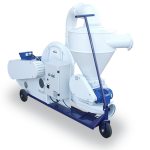
| SUC / SupraVac suction-pressure blowers (pneumatic) | up to 33 t/h (SUC-E, electric), up to 44 t/h (SUC-T), up to 64 t/h (SUC-TR), up to 120 t/h (SupraVac 2000) | conveys horizontally, vertically and around corners; capacity falls with the pipe run | mobile (on wheels, three-point linkage or trailer) | loading lorries and grain trailers, emptying flat stores and silos, changing work sites |
| TRL high-pressure blowers with injector or rotary valve (pneumatic) | approx. 2.3 to 91.6 t/h at 10 m conveying length, depending on model TRL 20 to TRL 1000 | performance table documented up to 200 m conveying length (with falling capacity); vertical sections and bends possible | stationary | fixed pipe run to several discharge points, awkward building layouts |
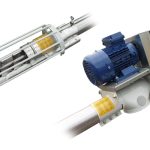
| DGA / DGS grain augers (mechanical) | up to 40 t/h (DGA), up to 60 or 90 t/h (DGS, horizontal) | up to 12.5 m (DGA) or 11.8 m (DGS); any angle from horizontal to vertical | flexible siting | short runs, filling and transferring at any angle |
| BCB belt conveyors (mechanical) | 60 to 80 t/h | up to 100 m; incline up to 15 degrees | stationary | long horizontal runs, especially gentle handling, seed grain |
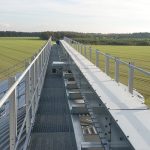
| KCC / KCA chain conveyors (mechanical) | up to 120 t/h (KCC), 30 to 120 t/h (KCA) | up to 50 m in length; KCA with incline up to 45 degrees | stationary | horizontal distribution over silo cells, intake pits without deep excavation |
| KBE bucket elevators (mechanical) | 20 to 120 t/h | up to 25 m lifting height | stationary | vertical conveying at intake, dryer and silo |
All figures come from the manufacturer’s product documentation and apply to the reference conditions stated there.
How far and how high can I convey pneumatically?
This question cannot be answered seriously with a single number of metres – because in pneumatic conveying there is no fixed limit, only a relationship between distance and capacity: the longer the pipe run, the fewer tonnes per hour arrive. The Kongskilde performance table for TRL pressure conveying systems documents conveying lengths from 10 to 200 metres, each with its corresponding throughput.
Three examples from that table make the effect tangible (basis: wheat at 700 kg/m³, 4 m of vertical conveying and two 90-degree bends in the run):
- TRL 100 with CA 20 rotary valve: 15.3 t/h at 10 m – still 1.9 t/h at 200 m.
- TRL 500 with CA 40: 49.5 t/h at 10 m – still 12.7 t/h at 200 m.
- TRL 1000 with CAD 50: 91.6 t/h at 10 m – still 23.5 t/h at 200 m.
So the right question is not How far can I convey? but How far can I convey while holding my target throughput? Someone who needs 20 t/h over 100 metres chooses a different blower from someone moving 20 t/h over 30 metres. Every additional bend and every metre of height beyond the reference conditions shifts the result further downwards.
The same applies to height: pneumatic systems convey vertically and around corners, but the height enters the calculation as a loss of capacity. For purely vertical tasks with a high continuous throughput, the mechanical bucket elevator, documented for 25 metres of lifting height and up to 120 t/h, is the more efficient choice.
Decision tree: four steps to the system
- Determine the volume: what throughput must be achieved at peak operation – at intake during harvest, say? The slowest link sets the capacity of the whole chain.
- Measure the route: note the horizontal length, the lifting height and the number of direction changes – the complete pipe run counts, not the straight line.
- Mobile or stationary? If work sites change (field edge, several stores, lorry loading), that argues for a mobile machine. A fixed conveying route served daily justifies a stationary plant.
- Choose the system:
- Mobile and changing sites: suction-pressure blower – electric up to 33 t/h (SUC-E), tractor-driven up to 64 t/h (SUC-TR) or up to 120 t/h (SupraVac 2000).
- Stationary, short run up to around 12 m at any angle: DGA or DGS grain auger.
- Stationary, long horizontal run up to 100 m, gentle: BCB belt conveyor.
- Stationary, distribution up to 50 m or intake pit with inclines up to 45 degrees: KCC/KCA chain conveyor.
- Stationary, vertical up to 25 m: KBE bucket elevator.
- Stationary, awkward route or several discharge points up to 200 m: TRL pressure conveying – model chosen from the performance table for each conveying length.
Recommended action: sizing your plant correctly
Plan consistently from the bottleneck: first fix the peak volume, then record the complete conveying route with all bends and heights, and only then select the system. With pneumatic plants, never calculate with the maximum figure from the brochure but with the table value for your actual conveying length – and build in a reserve for moister grain, because the reference value of 15% moisture is often exceeded in practice.
Think in combinations too: many farms do well with a stationary mechanical chain for the daily main route – pit, elevator and chain conveyor, say – and a mobile suction-pressure blower for loading and residue clearance. Both system families are modular and can be extended later, for instance when a stronger blower moves onto the existing pipe run in a TRL system. For day-to-day operation: wear parts such as pipes, bends and rotary valves help determine the capacity – matching spare parts are quickly narrowed down via the spare parts finder before the next harvest arrives.
Frequently asked questions
How far can I convey grain pneumatically?
How high can I convey grain?
How many tonnes per hour do I need?
Mobile or stationary – which is more economical?
Matching products
 High-Pressure Blowers – TRL →
 Suction Blowers – SUC and SupraVac →
 Pipes – OK →
 Pipes – FK →
 Bucket Elevators – KBE →
 Chain Conveyors – KCC and KCA →
 Tube Augers – DGA and DGS →
 Belt Conveyors – BCB →
Related guides
- Designing flat store aeration: ducts, air volumes, grain depths
- Emptying silos and flat stores completely: vacuum clean-out in practice
- Finding Kongskilde Spare Parts: How to Use the Exploded Drawing and Part Number
- Grain Cleaning: Why Pre-cleaning Pays Off
Exploded drawings and parts lists for all Kongskilde machines – with PDF download.
Open spare parts finder →