Those who take the crop straight from the combine harvester to the dryer or store always pay for drying and storing material that does not belong there: straw residues, chaff, dust, weed seeds and broken kernels. These impurities drive up drying costs, destabilise the store and ultimately depress the return. Consistent pre-cleaning is therefore one of the quickest levers for improving the economics of the entire grain chain.
What comes off the field besides the grain
Freshly threshed grain is never clean. Alongside the healthy kernels, it contains coarse components such as straw, ear fragments and clods of soil, fine fractions such as sand, dust and weed seeds, plus shrivelled and broken kernels from threshing. Green plant parts bring additional moisture with them, and damaged kernels have lost their natural protective coat.
This is more than a cosmetic flaw: the usual rules of thumb for safe storage are based on clean, undamaged grain. As soon as green matter and broken kernels come into play, the safety reserves shrink noticeably. The hectolitre weight – a central quality indicator in the trade – also directly reflects the share of light shrivelled kernels, dust and foreign matter.
Drying: why impurities cost real money
A dryer does not distinguish between grain and impurities – it heats and dehumidifies everything that passes through. Green plant parts and contaminants bind water and, during drying and handling, break down into light fine material that is separated out later anyway. The dirtier a lot comes off the field, the greater this loss. Those who dry impurities along with the grain are buying energy for material that ends up as screenings.
Then there is the airflow: dust and fines settle in dryers and ducting and disturb the even flow through the grain stream. Pre-cleaning immediately before the dryer, by contrast, ensures a uniform crop that air can flow through well – the available dryer capacity benefits the grain in full.
Storage stability: clean grain stores more calmly
After harvest, grain is living produce: every kernel respires, consuming reserves and releasing heat, water and carbon dioxide. In many regions, around one per cent of dry matter or more is lost during storage through this respiration alone. The moister and warmer the lot, the more intense this process – and the better the conditions found by the real pests: storage moulds, insects and mites. Storage moulds are regarded worldwide as the most important cause of losses of grain and seed; their toxins endanger humans and animals and devalue the lot even in small quantities.
Impurities aggravate this risk twice over. First, moist green parts and pockets of dust form zones of increased moisture in which moulds gain a foothold first. Second, fines clog the voids in the bulk: aeration no longer reaches all areas, and cooling and follow-up drying take longer or fail locally altogether. Clean, low-dust grain, by contrast, improves the air passage in the silo and makes hygiene between storage cycles easier.
Broken grain plays a special role: intact kernels are considerably better protected against moulds and many insects by their coat. Every broken kernel, by contrast, is an open door for infestation – one more reason to separate out the broken fraction before intake.
Aspiration or sieve cleaning: two principles, one task
Aspiration cleaning: separating by weight
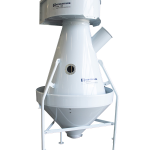
An aspirator passes the grain through an upward air stream. Light components such as chaff and dust are carried along and discharged via an outlet line, while the heavier, clean grain continues downwards. The blower-driven principle is easy to integrate into existing conveying lines. Ideally, the plant is designed so that the grain passes through the aspirator at every transfer – this keeps the material flow permanently clean and minimises deposits in bins and silos.
Sieve cleaning: separating by size
Sieve cleaning works mechanically: a first sieve holds back coarse impurities such as straw and clods, while the following sieve section lets the good grain pass and separates out smaller particles – sand, weed seeds and underdeveloped kernels. In combination units, an aspiration section follows, which extracts dust and light impurities. The screenings are discharged pneumatically via a cyclone into a container or trailer. High-performance combination units – such as the Kongskilde grain cleaners – achieve throughputs of up to 80 tonnes per hour.
| Feature | Aspiration cleaning | Sieve cleaning / combination unit |
|---|---|---|
| Separation principle | Weight (upward air stream) | Size (sieve sections), usually combined with extraction |
| Reliably removes | Dust, chaff, light impurities | Straw, clods, sand, weed seeds, shrivelled kernels |
| Broken and shrivelled kernels | only light fractions | targeted separation via the sieve section |
| Typical place of use | in the conveying line, at every transfer | before storage, sale or seed processing |
| Integration effort | low, runs along within the conveying process | higher, stand-alone cleaning station |
The two methods do not replace each other, they complement each other: the aspirator keeps the running material flow clean, while the sieve or combination unit prepares lots specifically for storage, sale or sowing. The category Cleaners provides an overview of suitable units of both designs.
Marketing: cleanliness is paid for
The grain trade settles on a weight basis – with premiums and deductions for moisture and cleanliness. Those who deliver impurities do not sell them, but pay for them through deductions. For food and feed grain, the rule is: sand, stones, dust and toxic weed seeds have no place in the product. With malting barley, small, protein-rich kernels are deliberately sieved out, and for seed, varietal purity and germination capacity are what count – high germination vigour is regarded in the trade as a universal sign of healthy, correctly treated grain. A cleaned, uniform lot therefore not only achieves better terms, it also spares discussions at delivery.
Conclusion: how to bring pre-cleaning into your operation
- Determine the impurities: Check the admixture level, broken kernels and hectolitre weight at intake – this shows how much potential lies in cleaning.
- Place an aspirator in the conveying line: Plan the material flow so that every transfer runs through the aspiration – before the dryer as well as before the silo.
- Combination cleaning for sale and seed: For marketable lots and home-saved seed, the combination of sieve and aspiration cleaning is worthwhile, as it also separates out sand, weed seeds and shrivelled kernels.
- Keep the unit maintained: Worn sieves and leaking air ducts cost separation accuracy. Suitable wear and spare parts can be found quickly via the spare parts finder.
Whether a retrofitted aspirator or a complete cleaning line: the investment works from the first tonne – in every drying run, in every storage year and in every settlement. The overview in the category Cleaners shows which solution suits the size of your plant.
Frequently asked questions
Why should grain be cleaned before drying?
What is the difference between aspiration cleaning and sieve cleaning?
Is an aspirator sufficient as the only cleaning stage?
How do impurities affect storability?
Matching products
Related guides
- Designing flat store aeration: ducts, air volumes, grain depths
- Emptying silos and flat stores completely: vacuum clean-out in practice
- Finding Kongskilde Spare Parts: How to Use the Exploded Drawing and Part Number
- Grain Conveying: Pneumatic or Mechanical?
Exploded drawings and parts lists for all Kongskilde machines – with PDF download.
Open spare parts finder →