Whether the grain travels through pipes in an air stream or moves on augers, chains and bucket elevators determines construction costs, energy demand and ease of work for many years. Both principles have clear strengths – the right choice depends less on the type of crop than on conveying route, throughput and farm structure. This guide sets the two systems side by side and shows which solution suits which type of farm.
Two principles, one goal: moving grain safely
Pneumatic conveying: pressure, suction or both
In pressure conveying, a high-pressure blower generates a powerful air stream. An injector or a rotary valve feeds the grain into the line, where it is carried through smooth pipes to the discharge point – horizontally, vertically and around obstacles. Diverter valves distribute the flow to several destinations as required, for example along an entire row of silos.
Suction conveying works the other way round: a vacuum picks the grain up via suction nozzle and hose directly from the floor, from the flat store or from the trailer. Suction-pressure blowers combine both methods in one machine – the grain is drawn in, separated from the conveying air in the cyclone and transferred to the pressure side via a rotary valve. According to the manufacturer, high-performance models achieve up to 120 tonnes per hour. The category Pneumatic Conveyors provides an overview of blowers, valves and pipe systems.
Mechanical conveying: auger, chain, bucket elevator and belt
Mechanical systems move the grain positively with moving components. Tube augers work at any angle from horizontal to vertical and handle up to 90 tonnes per hour. Chain conveyors transport horizontally over lengths of up to 50 metres at up to 120 tonnes per hour; angled versions cope with inclines of up to 45 degrees. Bucket elevators lift the crop vertically to heights of up to 25 metres, and belt conveyors move it particularly gently at 60 to 80 tonnes per hour over distances of up to 100 metres. The individual designs are presented in detail in the category Mechanical Conveyors.
Conveying route and installation: where is the difference?
The pneumatic system needs almost nothing in structural terms – only space for the pipeline. The blower stands at ground level, remains easily accessible and can be moved elsewhere or put under cover outside the season. This makes the equipment particularly suitable for older buildings, low store heights and winding routes where a straight conveyor line could not be installed at all. A single blower can fill and empty several silos via diverters.
Mechanical installations, by contrast, follow clearly defined axes: intake pit, angled or chain conveyor, bucket elevator and a conveyor run above the silo row. Those planning a new central plant thus gain a high-throughput backbone that, thanks to its modular design, is easy to extend when further silos are added. Fitting such lines into existing buildings at a later date, however, is more involved than laying a pipeline.
Capacity, energy and wear compared
Both system worlds achieve conveying capacities that keep pace with modern combine harvesters and continuous-flow dryers. The differences lie in the detail:
| Criterion | Pneumatic conveying | Mechanical conveying |
|---|---|---|
| Principle | Air stream carries the grain through pipes (pressure, suction or combined) | Auger, chain, buckets or belt move the grain directly |
| Conveying route | Freely routable, even around corners and obstacles; vertical and horizontal in one line | Fixed axes; horizontal up to approx. 50 m per run, vertical up to approx. 25 m with an elevator |
| Capacity range (manufacturer figures) | Mobile suction-pressure systems up to approx. 120 t/h | Depending on design approx. 20 to 120 t/h (belts 60–80 t/h, augers up to 90 t/h) |
| Residual emptying | Self-cleaning, no grain remains in the pipe system | Residual quantities possible in corners and troughs, self-emptying designs available |
| Energy demand | Higher, as the air must also be driven as the transport medium | Comparatively low, especially with belt and chain conveyors |
| Typical wear points | Pipe bends, rotary valves, blowers | Chains, buckets, bearings, auger flights |
| Mobility | Mobile units, including tractor-driven models without a mains connection | Stationary, but modularly extendable |
In terms of energy demand, mechanics has the edge by principle: it moves only the grain, not large volumes of air as well. Belt and bucket systems are regarded as particularly economical for continuous operation. Pneumatics pays for its freedom of pipe routing with more drive power – but in return does without moving parts along the entire route.
Wear is also distributed differently. In the pipeline it is concentrated at a few points such as bends and valves, which can be replaced in a planned manner. With mechanical conveyors, chains, bearings and buckets age throughout the entire installation. Both worlds are gentle on the grain if design and speed are right – smooth pipes and gently running belts avoid breakage in equal measure. Suitable wear and spare parts for both system worlds can be quickly narrowed down via the spare parts finder.
Flexibility in everyday use: mobile, combinable, completely clean
Pneumatics plays its greatest strength away from fixed conveying routes. Mobile suction-pressure blowers with tractor drive work without a mains connection and load grain directly at the field edge into trailers or lorries. The same equipment unloads lorries, wagons or ships and, after mechanical emptying, vacuums the last residual quantities out of silos and flat stores – a point that can be decisive for store hygiene, seed purity and switching between lots.
Mechanical installations counter with reliability in continuous operation: once planned, pit, elevator and chain run season after season with little operator effort. For sensitive seed there are self-emptying bucket elevators and gently running belt conveyors that carry the crop to the discharge point almost without agitation.
Decision guide: which system suits which farm?
- Arable farm with a central silo plant: Mechanics as the backbone – intake pit, bucket elevator and chain conveyor above the silo row deliver high continuous throughput at low energy demand and grow modularly.
- Farm with older buildings or a flat store: Pneumatics – only a pipeline is needed, the blower stands at ground level, major conversions are unnecessary. Ideal for low building heights and convoluted routes.
- Livestock farm with hopper silos: Both routes lead to the goal. A blower system with rotary valves serves several silos via one line; alternatively, angled conveyors and an elevator handle hopper filling and emptying.
- Seed production and multiplication business: Self-cleaning takes priority so that lots are not mixed – self-emptying bucket elevators and belt conveyors, or a pneumatic system that leaves no grain in the line after conveying.
- Contract work and field-edge loading: Mobile suction-pressure blowers with tractor drive that work independently of the mains at changing locations.
Conclusion: define the conveying task first, then choose the equipment
The question is rarely pneumatic or mechanical, but rather: where does which task lie? Proceed as follows:
- Map out the conveying routes: record distances, heights, corners and future extensions honestly.
- Define the throughput: the installation must match the intake capacity at harvest, not the average day.
- Estimate the operating hours: with many full-load hours on fixed routes, the lower energy demand of mechanics pays off; with changing tasks, the flexibility of pneumatics.
- Clarify the hygiene requirements: seed, organic lots and feed quality argue for self-cleaning solutions or pneumatic residual emptying as a supplement.
In practice, the combination often proves its worth: a mechanical main axis for the bulk flow, supplemented by a pneumatic system for loading, special routes and complete emptying. Those who use both principles in a targeted way move their grain quickly, gently and at predictable cost.
Frequently asked questions
Which conveying system uses less energy?
Why does residual grain remain after mechanical silo emptying?
Can I combine pneumatic and mechanical conveying?
What capacity do pneumatic grain conveyors achieve?
Matching products
 High-Pressure Blowers – TRL →
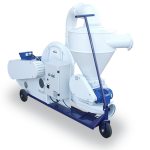 Suction Blowers – SUC and SupraVac →
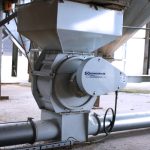 Rotary Valves – CAD/CAE →
 Pipes – OK →
 Bucket Elevators – KBE →
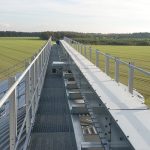 Chain Conveyors – KCC and KCA →
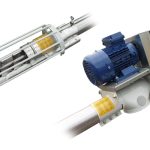 Tube Augers – DGA and DGS →
Related guides
- Designing flat store aeration: ducts, air volumes, grain depths
- Emptying silos and flat stores completely: vacuum clean-out in practice
- Finding Kongskilde Spare Parts: How to Use the Exploded Drawing and Part Number
- Grain Cleaning: Why Pre-cleaning Pays Off
Exploded drawings and parts lists for all Kongskilde machines – with PDF download.
Open spare parts finder →