When the combine is running, the equipment behind it has to keep pace: intake, conveying, cleaning, drying, aeration. If a V-belt snaps or a bearing seizes at the peak of harvest, it is not just one machine that stops but the entire grain flow. Yet the question “Will the equipment last the season?” can be answered weeks in advance – with a systematic inspection of each equipment area. The typical wear points are documented as separate items in the spare parts lists for each series; this checklist follows exactly that structure. Work through it in early summer and you order at leisure instead of at a standstill.
Blowers and pneumatic conveying
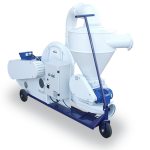
High-pressure blowers (TRL), suction blowers (SUC) and rotary valves (CAD/CAE) set the pace of pneumatic conveying – and run for many hours at a stretch during harvest. These points belong on the pre-season checklist:
- Guard grille on the intake side: check for damage and a clear cross-section. The grille is listed as a spare part in its own right and fits across the smaller sizes – one shared grille covers the TRL 20, 40 and 75, for example.
- Rotor and blower housing: look for contact marks and material loss. For the TRL 55 and TRL 75 the list carries rotor and housing as a complete unit – in case of wear, the whole assembly is replaced.
- V-belts and pulleys: On belt-driven machines such as the TRL 100/150 blowers and the SUC suction blowers, V-belts in SPZ profile and three-groove pulleys appear as separate items in the list. Belts age even when standing still – replace cracked or glazed ones and keep a set in stock.
- Clamping rings on the pipe connections: check for distortion and a secure fit. The clamping ring parts fit across the range from TRL 20 to 150; two parts make up one ring.
- Motor and motor protection: both are listed separately per size, some in several voltage variants – when ordering, the remarks column later decides which version is the right one.
All series for pressure and suction conveying are gathered in the category Pneumatic Conveyors.
Chain and bucket conveyors: chain, liners, bearings
For chain conveyors such as the KCC 40, the spare parts list almost reads as a maintenance schedule by itself, because the wear candidates are itemised individually there:
| Wear point | How it appears in the list (KCC 40) | What to look for |
|---|---|---|
| Conveyor chain | 5-metre section including connecting link | elongation and link-plate wear; if the chain can no longer be tensioned sensibly, replace it |
| Chain connecting link | connecting link, fits KCC 40 to 80 | keep in stock as an inexpensive emergency part |
| Wear liners | HDPE liners in four lengths (370, 670, 1270 and 2970 mm), plus separate liners for the drive and return sections | check the remaining thickness on the running surfaces |
| Flange bearings | Ø 40 mm on the return section, Ø 50 mm on the drive section | check for play and running noise |
| Sprocket and return roller | sprocket of the drive section; return roller complete with shaft | inspect the tooth profile, check the roller runs freely |
| Cleaning brush | brush for the intermediate outlet | check the state of the bristles |
Two details from the list help with planning: the drive shafts exist in four diameters (35, 40, 50 and 60 mm) – before ordering, measure the installed diameter or take it from the remarks. And some parts are identical across series: the flange bearing of the KCC return section carries the same part number as the boot bearing of the KBE 20/40 bucket elevators. If you run both machines, one part in stock covers two conveyors. Also listed is the switch of the overflow flap – test its function before the season so that the monitoring works during harvest operation.
Separate lists exist for the KBE 20 to 120 bucket elevators; here the head and boot sections with their bearing points deserve the closest look. If a part is missing, the spare parts finder leads from the type designation straight to the matching exploded drawing.
Augers: robust, but not maintenance-free
Grain augers (DGS 205 and 254, DGA and DGC 102 to 152) and trough augers (DTA 102 to 254) are considered uncomplicated – which is exactly why they tend to be skipped during the inspection. Three points are enough:
- Auger flighting: inspect the edges for wear, especially in the intake area – a worn-down flight costs conveying capacity.
- Bearing points: check for play and running noise, grease where intended.
- Drive and guards: check drive components and guards for condition and a firm fit.
Each of these series has its own spare parts list with an exploded drawing – so the part number is quickly determined even for older augers. All designs, from the auger through the chain to the bucket elevator, are shown in the category Mechanical Conveyors.
Cleaners and aeration
Cleaners: the screens decide
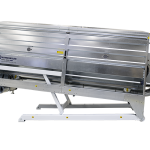
With cleaners such as the KDC combi-cleaners and the KF aspirators, the result stands or falls with intact screens and a clear air path. The screen sets are listed as spare parts in fine gradations – for the KDC 4000/5000, for instance, slotted screens from 1.0 to 4.0 mm width with a slot length of 16.5 mm, and round-hole screens from 2.0 to 9.5 mm.
- Check the screens for holes, deformation and battered edges – damaged screens distort the grading.
- Check that the matching screen set is complete for every crop you plan to handle; reordering in the middle of the campaign costs valuable days.
- Clear the air passages and the aspiration of dust and deposits.
The category Cleaners shows which cleaner series are available.
Aeration: quiet equipment, expensive failures
Aeration fans such as the FRL centrifugal fans and storage silos of the KCT type often run unobserved for weeks after intake – a fault only shows once the store warms up. So before the season: check that the impeller runs freely and is clear of deposits, inspect the guard grilles and electrical equipment, and check ducts and transitions for tightness. Separate spare parts lists exist for this equipment too. Fans, ducts and silo systems for store aeration are grouped in the section Drying and Storage Systems.
Finding the part number in three steps
If a part fails the inspection, the route to the order number is short:
- Read the nameplate: note the type designation, size and serial number – these details are right on the machine and make the assignment unambiguous.
- Open the family in the spare parts finder: one list often covers the whole series – the TRL blowers 20, 40, 55 and 75, for example, share one document in which each size has its own section with its own drawing. So it is important to choose the section for your own size.
- Locate the item in the drawing: find the part in the exploded drawing, look up the item number in the table and read off the nine-digit part number. If there are several variants – shafts in different diameters, say, or motors for different voltages – the remarks column clarifies which row belongs to your machine.
Recommended action: put together your pre-harvest package
The inspection becomes a plan once you assign every finding to one of three piles:
- Replace now: everything that clearly will not last the season – cracked V-belts, elongated chains, worn-through wear liners, damaged screens.
- Keep in stock: inexpensive key parts with a big effect – one belt set per belt-driven machine, a chain connecting link, flange bearings and the screens for your main crops.
- Watch and record: note items showing early wear together with their part numbers – the next order then becomes a routine job.
In addition, file the nameplate details of all machines in one central place. Together with the spare parts finder, any part number can then be determined in a few minutes even under time pressure – and the question “Will the equipment last?” is answered not on the first day of harvest but weeks beforehand: with an hour of inspection per equipment area and a small, well-chosen parts stock.
Frequently asked questions
Which spare parts should I stock before harvest?
How do I find the part number of a wear part?
Does one spare parts list cover the whole series?
Why are wear liners listed in several lengths?
Matching products
 High-Pressure Blowers – TRL →
 Suction Blowers – SUC and SupraVac →
 Chain Conveyors – KCC and KCA →
 Bucket Elevators – KBE →
 Grain Cleaners – KDC →
Related guides
- Designing flat store aeration: ducts, air volumes, grain depths
- Emptying silos and flat stores completely: vacuum clean-out in practice
- Finding Kongskilde Spare Parts: How to Use the Exploded Drawing and Part Number
- Grain Cleaning: Why Pre-cleaning Pays Off
Exploded drawings and parts lists for all Kongskilde machines – with PDF download.
Open spare parts finder →