A grain store only counts as empty once the last kernel has been removed. That is exactly where mechanical emptying regularly fails: in the corners of large silos, along the walls of flat stores and around outlet openings, noticeable quantities remain after outloading. These residues are not a cosmetic flaw but a real risk – they spoil, attract pests and can burden the next intake from the start.
This practical article shows why augers and chain conveyors cannot reach the residue by design, how clean-out with suction air works in detail, which suction-pressure blowers of the SUC and SupraVac series suit which farm size, and where the limits of the method lie.
Why mechanical equipment cannot reach the residue
Mechanical conveying plants are fixed installations. They only take the grain that flows to them by gravity – everything else stays put. In large silos and in flat storage areas in particular, corners and edges are simply out of reach for permanently installed equipment. Every farm manager knows the result: after mechanical unloading, considerable quantities of grain often remain in the store, bringing losses, spoilage and hygiene problems in their wake.
Typical situations in which residues arise:
- Flat-bottom silo: around the outlet and along the silo wall a ring of grain remains that the discharge system no longer captures.
- Flat store: the loader cannot get cleanly up to partition walls, columns and the corners of the storage bays.
- Intake and transhipment: tipped grain lies on the floor and is to be loaded onward without an intermediate hopper.
- Partial outloading: after individual lots are sold, residues are spread across the whole storage floor.
The classic way out – broom, shovel and plenty of manual work – costs time and still delivers no hygienically clean result.
Vacuum clean-out: how the extraction works
Pneumatic conveying tackles the problem from the other side: instead of waiting for grain to flow to the equipment, the equipment comes to the grain. The operator guides a mobile suction nozzle on light hoses freely across the storage floor and picks up left-over grain exactly where it lies – even in the furthest corner. The store is cleared thoroughly, down to the last kernel, and tedious sweeping by hand is largely eliminated.
The path of the grain through the plant in four steps:
- The blower generates a powerful airstream that draws the grain through the suction nozzle and hose into the pipeline.
- In the suction cyclone the grain is separated from the conveying air.
- Via a rotary valve it passes to the pressure side of the blower.
- From there it is conveyed through the pipeline to its destination – horizontally, vertically and around corners, and gently on the grain.
At the end of the run, a discharge cyclone delivers the grain straight into a trailer or container. Sound grain can be used or sold on, spoiled residues go separately for disposal.
SUC and SupraVac: the right blower for every farm size
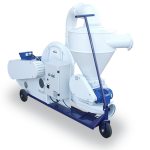
Kongskilde builds the suction-pressure blowers of the SUC and SupraVac series in electric and in tractor-driven versions. All models work on the same principle and differ mainly in drive, format and conveying capacity – an overview of the whole product group can be found under Pneumatic Conveyors.
| Model | Drive | Format | Capacity up to |
|---|---|---|---|
| SUC E | Electric motor | mobile on wheels or stationary | 33 t/h (mobile), 64 t/h (stationary) |
| SUC-T | Tractor PTO | three-point linkage | 44 t/h |
| SUC-TR | Tractor PTO | trailer with loading attachment | 64 t/h |
| SupraVac 2000 | Tractor PTO (170 hp) | trailer with hydraulically folding loading boom | 120 t/h |
The capacity figures refer to free-flowing grain; for the SupraVac 2000 the 120 t/h applies at a bulk density of 700 kg/m³ and a maximum grain moisture of 15 percent.
Working off-grid with PTO drive
The tractor-driven models make clean-out independent of the mains. The SUC-T hangs compactly in the three-point linkage, while the SUC-TR and SupraVac 2000 travel along as trailers – so a remote flat store, a rented building without three-phase power or a heap of grain at the field edge can all be dealt with. For enclosed buildings in which no tractor should operate, the electrically driven SUC E is the right choice: the mobile models stand on wheels and are easily pushed from one job to the next.
Practical for growing farms: if the capacity requirement rises, a larger blower can carry on working on the existing pipe system – the investment in the pipeline is preserved.
From floor heap onto lorry and wagon
The same suction technology also handles transhipment: tipped grain is sucked up straight from the floor or drawn directly off the lorry bed with an unloading attachment. No intermediate hoppers are needed, which greatly simplifies logistics in the yard, in the store and at transfer points. Combined with a fixed pipe system, the material can be conveyed straight into railway wagons or other transport units; a material flow in both directions is possible too – loading and unloading with the same plant.
For the farm this means: a suction-pressure blower is not just a cleaning machine. It empties the silo completely, then loads the grain onto trailers or lorries and helps again with the next transport.
Limits of the method: moisture and compaction
Flexible as suction conveying is – it needs free-flowing material. Two factors limit the performance in practice:
- Grain moisture: the rated capacities apply to dry grain; for the SupraVac 2000, Kongskilde explicitly states a maximum of 15 percent moisture as the reference value. Moister grain is heavier, flows more sluggishly and pulls the throughput down noticeably – allow more time here.
- Compaction: the suction nozzle only picks up what can be loosened. Trodden-down areas or crusted layers, for instance after moisture ingress at walls and floors, must be loosened mechanically before extraction. Heavily clumped, spoiled lots do not belong in the conveying flow with the sound grain but go separately for disposal.
Know these limits and plan for them and there are no surprises: for the typical clean-out after regular outloading – dry, storable grain in corners and edge zones – suction conveying is the method of choice.
Recommended action: five steps to a completely empty store
- Record the residue points: after the next emptying, walk through the silo and flat store and note where grain is left behind and in what quantity.
- Settle the drive question: if sufficient power is available at the store, much speaks for the SUC E; off-grid sites are the case for the PTO-driven models SUC-T, SUC-TR or SupraVac 2000.
- Size the capacity: choose the blower size according to the residue quantity and the available time window – the pipe system can be reused if you later switch to a stronger model.
- Provide the receiving vessel: place a trailer or container under the discharge cyclone and keep usable grain strictly separate from spoiled residues.
- Make it routine: make vacuum clean-out a fixed step before every refilling – so every lot starts in a clean store.
The quickest way to narrow down which model size suits your farm is the spare parts finder – or talk directly to a specialist dealer about sizing the blower and pipe system.
Frequently asked questions
Why does grain remain in the silo after mechanical emptying?
Does vacuum clean-out also work without a mains connection?
Where does the extracted grain go?
What role does grain moisture play in extraction?
Matching products
Related guides
- Designing flat store aeration: ducts, air volumes, grain depths
- Finding Kongskilde Spare Parts: How to Use the Exploded Drawing and Part Number
- Grain Cleaning: Why Pre-cleaning Pays Off
- Grain Conveying: Pneumatic or Mechanical?
Exploded drawings and parts lists for all Kongskilde machines – with PDF download.
Open spare parts finder →